


The Deal Summary
AI-powered insights at a glance
Sales managers were struggling to comb through the vast amount of data that tells the story of a deal. They had to do a scavenger hunt browsing through multiple data fields, looking through recordings of recent meetings, reviewing email threads, and constantly badgering their account executives just to understand what was currently going on with a deal. And that’s just for one deal. They are managing hundreds.
The deal summary was designed to alleviate that pain and provide a single point of reference to understand what was going on in a deal, giving managers back valuable time to do what they need to do most - help push the deal over the finish line.
Role
Lead Designer
Timeframe
6 months
Company
Salesloft
Year
2024
CHALLENGE OVERVIEW
Information overload
Salesloft works with a large and diversified mix of data that contributes to the overall attributes of an open deal. All of this data combined creates the story of a deal and whether it is healthy or not. Combing through all of this data across hundreds of open deals to find the health, risks, and potential action items of those deals is incredibly time-consuming and tedious. Sales managers sat on top of this rich set of data with no means to scale their understanding of the deals that needed their attention. Without visibility into which deals needed their coaching or engagement, deals could fall through the cracks and fail to close. Our goal was to find a way to present all of this information in a more digestible format to streamline the way managers stayed on top of deals and supported their Account Executives in getting the deal done.
As the lead designer, I crafted design concepts and user interactions, ensuring an intuitive user experience. I collaborated with the research team on interviews and testing, my product manager on strategy, my development team on feasibility, and the data science team on integrating a Large Language Model (LLM) to summarize complex deal data, aligning design with both technical and user needs.
PART ONE
Defining the Problem
Problem Discovery
DEFINING THE PROBLEM
An initial discovery was run with the goal of understanding how Sales Managers currently manage their deals so we could evolve our product to support their management process more effectively.
User Interviews
10 interviews were conducted with Sales Managers. While they were a variety of findings from these conversations, we narrowed in on one key problem that was causing a significant pain point for our users. From this finding we developed our problem statement and began crafting our proposed solution to the problem - The Deal Summary.
Sales managers need a streamlined way to monitor deal health and progress because inefficient management and lack of real-time insights leads to lost deals and inaccurate forecasts.
PROBLEM STATEMENT
PART TWO
Summarizing a Deal
Information Consolidation
SUMMARIZING A DEAL
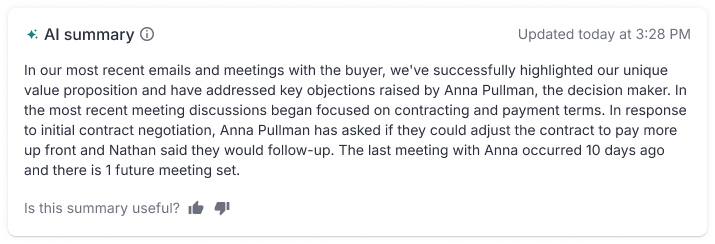
With a tight timeline, I dove in to initial design concepts. There was a lot of information sales managers were digging through, and we decided that this would be an excellent time to utilize AI to do the hard work for our users. The foundation of our concept was to develop a LLM that would take both structured and unstructured data about a deal to generate a brief summary of what was currently going on in a deal so that managers would no longer have to do that digging.
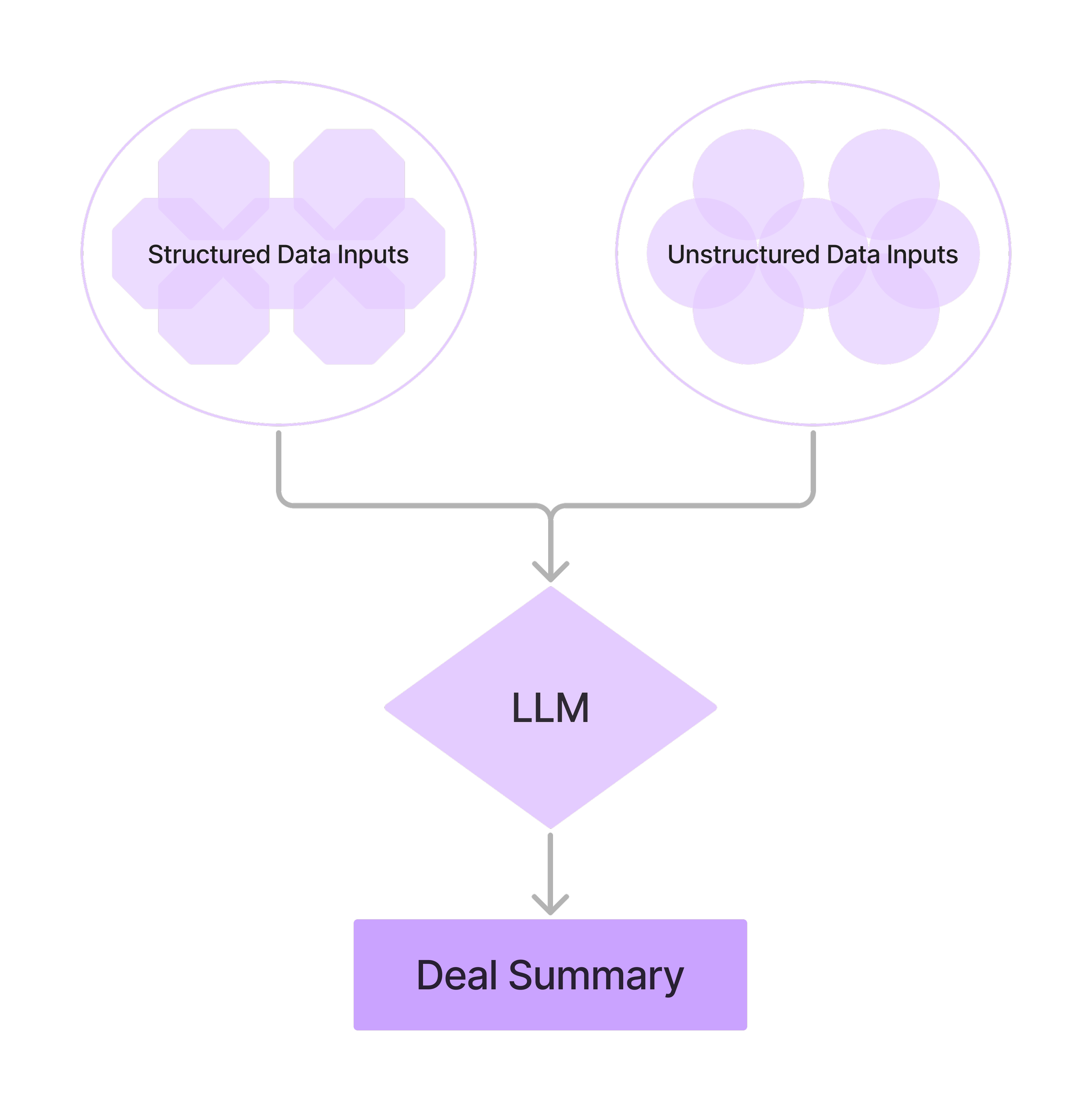
LLM
Working with both data science and product management, we discussed the best data inputs for this LLM. This included incorporating structured data like CRM (Customer Relationship Management) data fields including stage, amount, close date, etc. as well as unstructured data including things like conversation summaries and topics discussed in emails. From here we developed a prompt for the system that would be used to generate the deal summary.
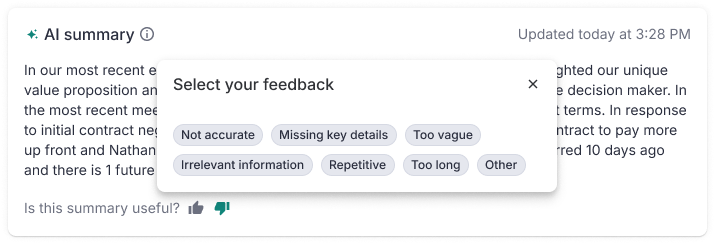
In support of this, I also designed a feedback mechanism for users to let us know how well the summary is working and so we can modify and improve our prompt for the LLM as needed.
Supporting Visuals
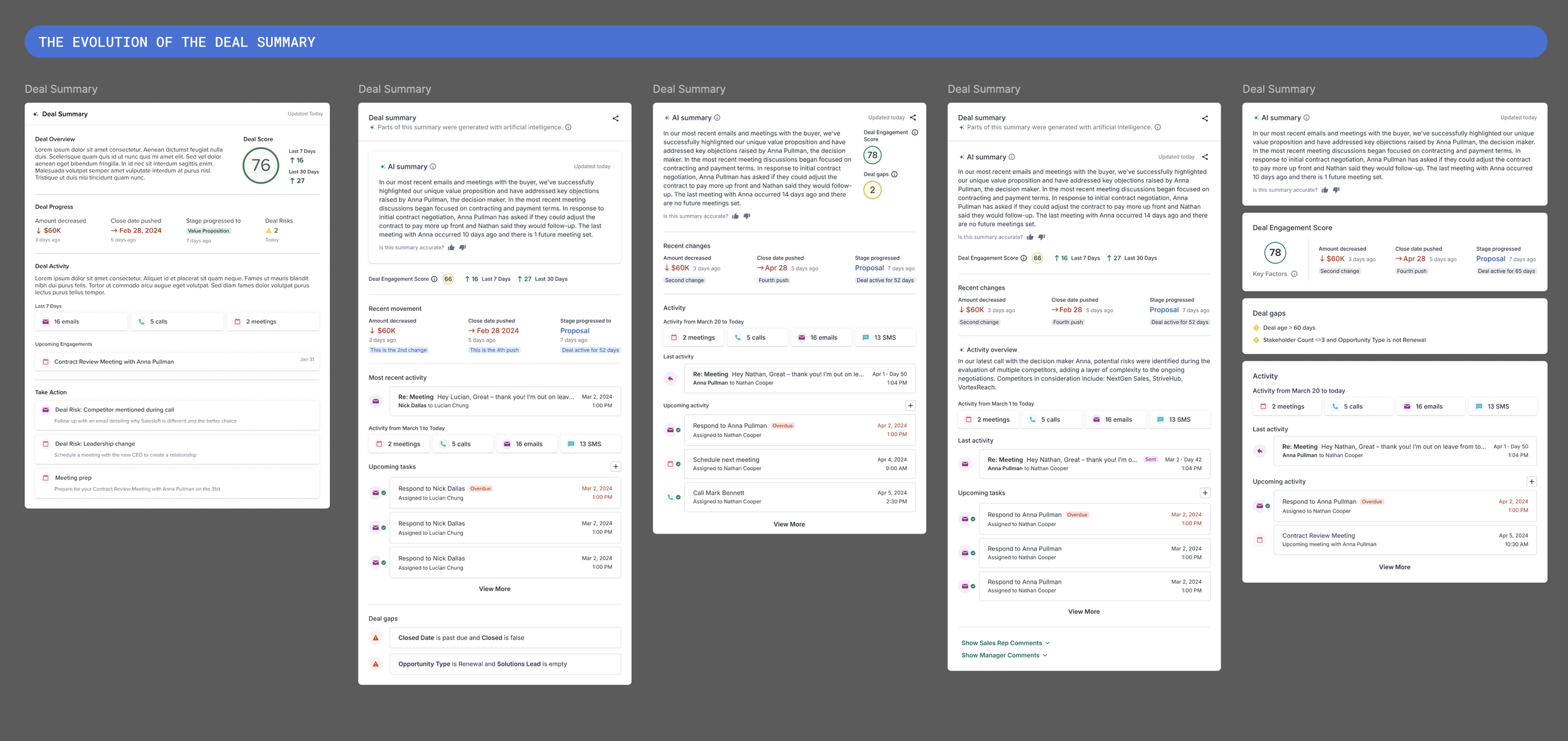
While the main focus of this effort was on generating a summary of the deal, we also wanted to reexamine the way we presented the supporting information surrounding a deal in a scannable format. From our research, we had identified the following key supporting areas:
Progression indicators (Things like close date, deal stage, deal amount)
Deal Gaps (Data points that can negatively affect a deal)
Deal Activity
We also wanted to use this as an opportunity to review the utilization of our existing Deal Engagement Score.
With all of this in mind I iterated through a number of design concepts before ultimately landing on our final version that we then brought in to usability testing.
PART THREE
Putting it to the test
Usability Testing
PUTTING IT TO THE TEST
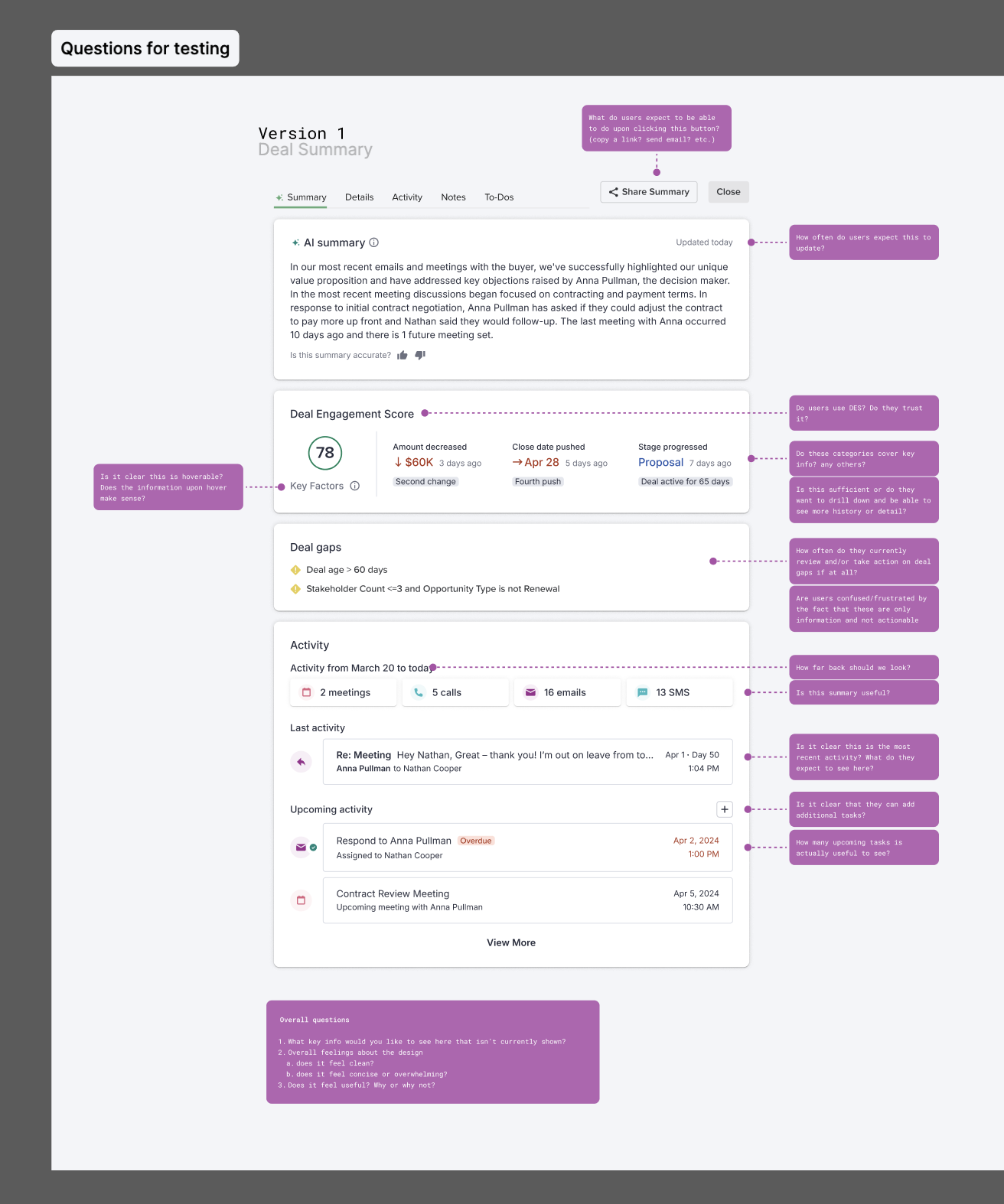
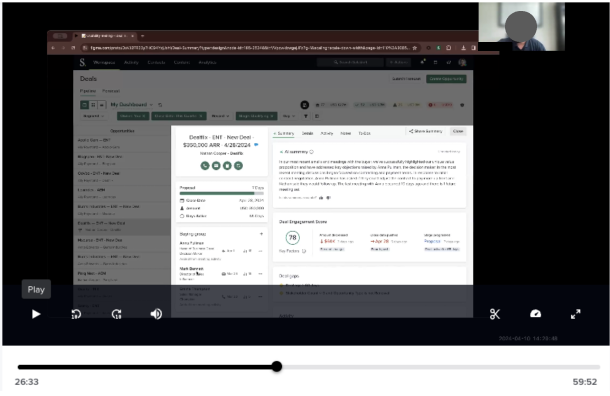
With our initial design concepts in hand, we set out to meet with 8 different users including 5 sales managers and 3 account executives in order to evaluate to what extent our proposed designs met user needs for gathering an overview of an opportunity. We spent the first part of the session reviewing participant’s current process for getting a summary of a deal as well as understanding their trust of AI. For the second half we moved in to testing our initial design concepts.
User Feedback
While improving our designs was a key takeaway from our conversations, so was the validation of our concept from the feedback we got from users. They were very excited to learn about this upcoming feature and saw the benefits it would have to their workflow.
“I love this. Something like this would be hugely helpful. It takes so much time for me to dig through all of this information now, so to have it be done for me would be amazing.”
PART FOUR
Iterating & Improving
Enhancing the design
ITERATING & IMPROVING
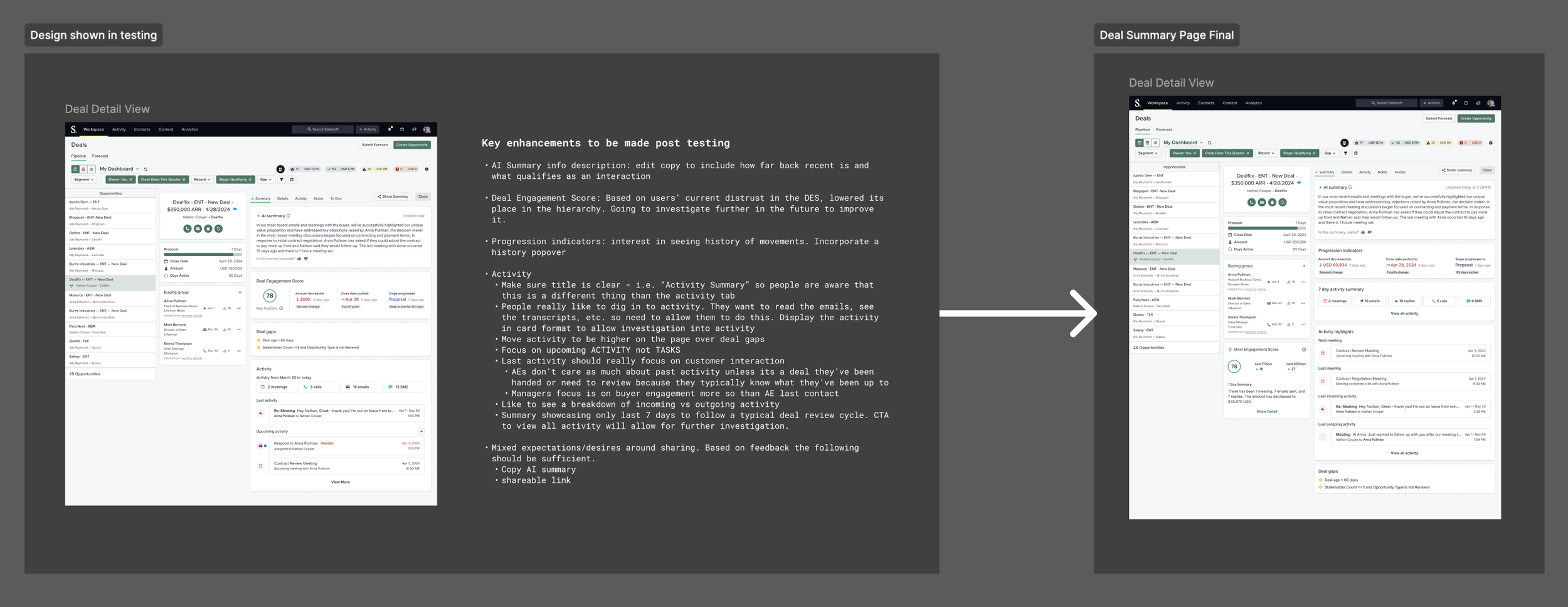
From our testing with users, we had a number of takeaways that allowed us to enhance our designs. This included things like clarifying how and when the deal summary was generated, including additional history and explainability around progression indicators, deprioritizing the deal engagement score until the accuracy of that feature was enhanced, and reformatting the way we display the most recent activity.
User flows
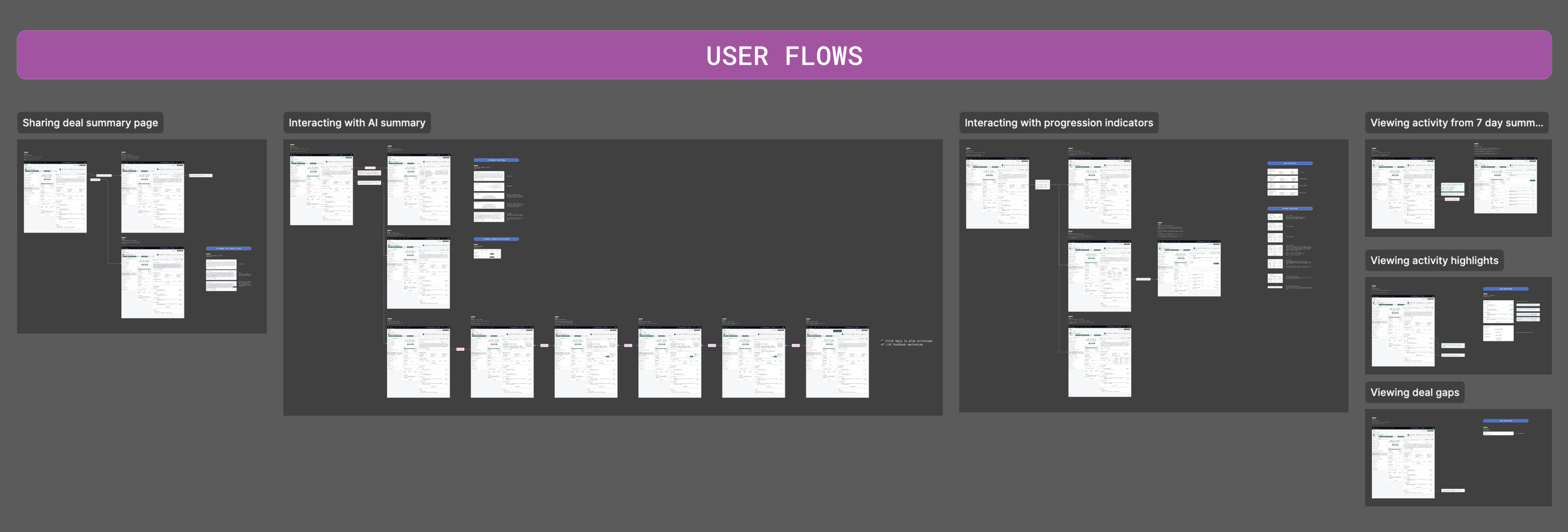
In support of our handoff to development I also outlined all potential user flows throughout the page. This broke down the various potential interactions and states for each component on the page.
Moving forward
Our next steps are building, launching, and monitoring the feature! With its release we plan to monitor usage and summary feedback with the hopes of continually improving our LLM output based on user feedback as well as incorporating additional data sources to provide the best summary possible.
View More
Mobile and web-based application with a bespoke content management system designed to improve school-to-parent communications.

Replatforming and redesigning Hitachi’s network of European websites.
